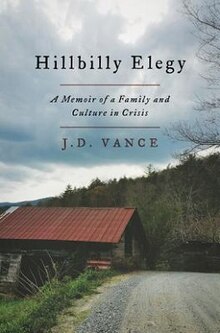
Hillbilly Elegy: a Memoir of a Family and Culture in Crisis by J.d. Vance.
 | |
| Writer | J. D. Vance |
|---|---|
| Language | English |
| Subject | Rural sociology, poverty, family drama |
| Published | June 2016 (Harper Press) |
| Publisher | Harper |
| Pages | 264 |
| Awards | Audie Award for Nonfiction |
| ISBN | 978-0-06-230054-6 |
| OCLC | 952097610 |
| LC Grade | HD8073.V37 |
Hillbilly Elegy: A Memoir of a Family and Culture in Crunch is a 2016 memoir past J. D. Vance almost the Appalachian values of his Kentucky family and their relation to the social problems of his hometown of Middletown, Ohio, where his mother'due south parents moved when they were young.
Summary [edit]
Vance describes his upbringing and family background while growing up in the city of Middletown, Ohio, the third largest urban center in the Cincinnati metropolitan area. He writes most a family history of poverty and low-paying, physical jobs that have since disappeared or worsened in their guarantees, and compares this life with his perspective afterward leaving information technology.
Though Vance was raised in Middletown, his mother and her family were from Breathitt Canton, Kentucky. Their Appalachian values include traits like loyalty and love of country, despite social issues including violence and verbal abuse. He recounts his grandparents' alcoholism and corruption, and his unstable mother'due south history of drug addictions and failed relationships. Vance's grandparents eventually reconciled and became his de facto guardians. He was pushed by his tough simply loving grandmother, and eventually Vance was able to leave Middletown to nourish Ohio State University and Yale Law School.[1]
Aslope his personal history, Vance raises questions such as the responsibility of his family and people for their own misfortune. Vance blames hillbilly culture and its supposed encouragement of social rot. Comparatively, he feels that economic insecurity plays a much lesser role. To lend credence to his argument, Vance regularly relies on personal experience. As a grocery store checkout cashier, he watched welfare recipients talk on cell phones although the working Vance could not afford one. His resentment of those who seemed to profit from poor behavior while he struggled, particularly combined with his values of personal responsibility and tough love, is presented as a microcosm of the reason for Appalachia's overall political swing from potent Democratic Party to strong Republican affiliations. Likewise, he recounts stories intended to showcase a lack of work ethic including the story of a human being who quit after expressing dislike over his chore'due south hours and posted to social media almost the "Obama economy", equally well as a co-worker, with a pregnant girlfriend, who would skip work.[one]
Publication [edit]
The volume was popularized by an interview with the author published by The American Conservative in belatedly July 2016. The volume of requests briefly disabled the website. Halfway through the next month, The New York Times wrote that the title had remained in the meridian x Amazon bestsellers since the interview's publication.[one]
Vance credits his Yale contract law professor Amy Chua as the "authorial godmother" of the book.[2]
Reception [edit]
The book reached the elevation of The New York Times Best Seller list in August 2016[3] and January 2017.[4] Many journalists criticized Vance for generalizing as well much from his personal upbringing in suburban Ohio.[5] [6] [seven] [8]
American Conservative correspondent and blogger Rod Dreher expressed admiration for Hillbilly Elegy, saying that Vance "draws conclusions…that may exist hard for some people to take. Merely Vance has earned the right to brand those judgments. This was his life. He speaks with authority that has been extremely hard won."[9] The following calendar month, Dreher posted about why liberals loved the book.[x] New York Post columnist and editor of Commentary John Podhoretz described the book equally among the yr'due south most provocative.[11] The book was positively received by conservatives such every bit National Review columnist Mona Charen[12] and National Review editor and Slate columnist Reihan Salam.[xiii]
By contrast, Jared Yates Sexton of Salon criticized Vance for his "dissentious rhetoric" and for endorsing policies used to "gut the poor." He argues that Vance "totally discounts the office racism played in the white working form's opposition to President Obama."[14] Sarah Jones of The New Republic mocked Vance as "the false prophet of Blue America," dismissing him as "a flawed guide to this globe" and the book as little more than "a list of myths well-nigh welfare queens repackaged as a primer on the white working class."[6] The New York Times wrote that Vance's direct confrontation of a social taboo is admirable regardless of whether the reader agrees with his conclusions. The newspaper writes that Vance's discipline is despair, and his statement is more generous in that information technology blames fatalism and learned helplessness rather than indolence.[one] Historian Bob Hutton wrote in Jacobin that Vance'south argument relied on circular logic and eugenics, ignored existing scholarship on Appalachian poverty, and was "primarily a piece of work of cocky-congratulation."[5] Sarah Smarsh with The Guardian noted that "nearly downtrodden whites are not conservative male person Protestants from Appalachia" and chosen into question Vance's generalizations about the white working grade from his personal upbringing.[7]
A 2017 Brookings Establishment study noted that, "JD Vance's Hillbilly Elegy became a national bestseller for its raw, emotional portrait of growing upwards in and eventually out of a poor rural community riddled by drug addiction and instability." Vance's account anecdotally confirmed the report's determination that family stability is essential to upward mobility.[15] The volume provoked a response in the class of an anthology, Appalachian Reckoning: A Region Responds to Hillbilly Elegy, edited past Anthony Harkins and Meredith McCarroll. The essays in the book criticize Vance for making broad generalizations and reproducing myths nearly poverty.[8]
Film adaptation [edit]
A film adaptation was released in select theaters in the United States on November 11, 2020, then digitally on Netflix on November 24. It was directed past Ron Howard and stars Glenn Close, Amy Adams, Gabriel Basso[16] [17] and Haley Bennett. Although a few days of filming were planned for the book'southward setting of Middletown, Ohio,[xviii] much of the filming in the summertime of 2019 was in Atlanta, Clayton and Macon, Georgia, using the lawmaking name "IVAN."[19] [20]
References [edit]
- ^ a b c d Senior, Jennifer (Baronial x, 2016). "Review: In 'Hillbilly Elegy,' a Tough Dear Analysis of the Poor Who Back Trump". The New York Times. Archived from the original on October eleven, 2016. Retrieved October xi, 2016.
- ^ Heller, Karen (Feb 6, 2017). "'Hillbilly Elegy' made J.D. Vance the voice of the Rust Chugalug. But does he want that job?". The Washington Mail. Archived from the original on November 25, 2020. Retrieved March 13, 2017.
- ^ Barro, Josh (August 22, 2016). "The new memoir 'Hillbilly Elegy' highlights the cadre social-policy question of our fourth dimension". Business Insider. Archived from the original on February 13, 2017. Retrieved March 13, 2017.
- ^ "Combined Print & E-Book Nonfiction Books – Best Sellers – Jan 22, 2017". The New York Times. Archived from the original on January 27, 2017. Retrieved February 12, 2017.
- ^ a b "Hillbilly Elitism". jacobinmag.com. Archived from the original on May vii, 2020. Retrieved April two, 2020.
- ^ a b Jones, Sarah (November 17, 2016). "J.D. Vance, the Faux Prophet of Blue America". The New Commonwealth. Archived from the original on March 17, 2017. Retrieved March 22, 2017.
- ^ a b Smarsh, Sarah (Oct 13, 2016). "Unsafe idiots: how the liberal media elite failed working-form Americans". The Guardian. ISSN 0261-3077. Archived from the original on April xviii, 2020. Retrieved April 19, 2020.
- ^ a b Garner, Dwight (February 25, 2019). "'Hillbilly Elegy' Had Strong Opinions Virtually Appalachians. At present, Appalachians Return the Favor". The New York Times. ISSN 0362-4331. Archived from the original on February 21, 2020. Retrieved Apr 2, 2020.
- ^ Dreher, Rod (July 11, 2016). "Hillbilly America: Practise White Lives Affair?". The American Conservative. Archived from the original on March 22, 2017. Retrieved March 22, 2017.
- ^ Dreher, Rod (August five, 2016). "Why Liberals Love 'Hillbilly Elegy'". The American Conservative. Archived from the original on October 12, 2016. Retrieved March 22, 2017.
- ^ Podhoretz, John (October 16, 2016). "The Truly Forgotten Republican Voter". Commentary. Archived from the original on Feb 25, 2017. Retrieved March 12, 2017.
- ^ "Hillbilly Elegy: J.D. Vance's New Book Reveals Much virtually Trump & America". National Review. July 28, 2016. Archived from the original on March 18, 2017. Retrieved March 22, 2017.
- ^ "Reihan Salam on Twitter: "Very excited for @JDVance1. HILLBILLY ELEGY is excellent, and it'll be published in late June:"". Twitter. April 30, 2016. Archived from the original on Apr 17, 2017. Retrieved March 22, 2017.
- ^ Jared Yates Sexton (March xi, 2017). "Hillbilly sellout: The politics of J. D. Vance'south "Hillbilly Elegy" are already being used to gut the working poor". Salon. Archived from the original on March 18, 2017. Retrieved March 22, 2017.
- ^ Eleanor Krause and Richard V. Reeves (2017) Rural Dreams: Upward Mobility in America's Countryside, pp.12–13. Brookings Establishment. https://www.brookings.edu/wp-content/uploads/2017/08/es_20170905_ruralmobility.pdf Archived Dec 6, 2020, at the Wayback Machine
- ^ Williams, Trey (Apr 12, 2019). Close%5d%5d plays a strong dame, Mamaw, who saves the hero./ "Ron Howard-Directed 'Hillbilly Elegy' Casts Gabriel Basso in Lead Role". TheWrap. Archived from the original on May 13, 2019. Retrieved July 5, 2019.
- ^ WKRC (April 16, 2019). "'Hillbilly Elegy' expected to be filmed locally; more than cast members sign on". Local 12/WKRC-Tv. Archived from the original on April 17, 2019. Retrieved July 5, 2019.
- ^ Kiesewetter, John (June 3, 2019). "Glenn Close, Amy Adams, Visit Middletown For 'Hillbilly Elegy' Meeting". WVXU Cincinnati Public Radio. Archived from the original on June vii, 2019.
- ^ Walljasper, Matt (June 27, 2019). "What's filming in Atlanta now? Lovecraft Country, The Conjuring 3, Waldo, Hillbilly Elegy, and more than". Atlanta Magazine. Archived from the original on June 28, 2019. Retrieved July 5, 2019.
- ^ Chandler, Tom (July 3, 2019). "Netflix to begin filming flick 'Ivan' in Macon". The Georgia Sun. Archived from the original on July 5, 2019. Retrieved July five, 2019.
External links [edit]
- Official website
- C-Span Q&A interview with Vance on Hillbilly Elegy, October 23, 2016
Source: https://en.wikipedia.org/wiki/Hillbilly_Elegy
0 Response to "Hillbilly Elegy: a Memoir of a Family and Culture in Crisis by J.d. Vance."
Enregistrer un commentaire