Commentary: Save forests or build 4-rooms? It’s not a zero-sum game
SINGAPORE: In late October, drone footage of Clementi Forest went viral, and many came to learn of and appreciate its wild beauty.
But after learning that the state had been earmarked for residential development, some netizens accept called for its preservation, shining a spotlight on the dilemma of conserving forests in country-deficient Singapore.
A petition to protect Clementi Forest on Modify.org has amassed over ten,000 signatures since its launch on Oct 26.
In response to queries, the Urban Redevelopment Authority (URA) said on Nov 30 that while Clementi Forest is classified as "Residential (Subjected to Detailed Planning)", there are no immediate plans for development yet.
Apart from providing visually stunning landscapes, preserving densely vegetated areas has many practical benefits. They help mitigate the effects of climate change by absorbing carbon dioxide from the temper, reducing urban heat and preventing floods.
Sizable forests besides act as wildlife corridors that connect nature reserves, promoting fauna diversity and overall health of forests.
READ: Commentary: Let Singapore'southward green spaces grow wild
READ: Commentary: Beautiful otters and pangolins go saved but are ugly animals a lost conservation cause?
Construction AND CONSERVATION, A ZERO-SUM GAME?
However, Clementi Forest, like other secondary forests (forests that accept regrown after country was cleared for agriculture and other uses) in Singapore has been viewed as a temporary landscape awaiting development.
Based on URA plans, almost one-half of existing secondary forests, roofing a total area of about iv,700ha, could be converted into new development land uses, such as residential, commercial, establishment and reserve sites within the adjacent 10 to fifteen years.
Extensive forest loss could take adverse consequences. We can experience them in the form of flash floods – the latest episode of which had dilapidated Upper Paya Lebar Route, Lorong Gambir and Mount Vernon Road on Nov ii. Such floods arise when there is less vegetation to absorb and slow rainwater runoff.
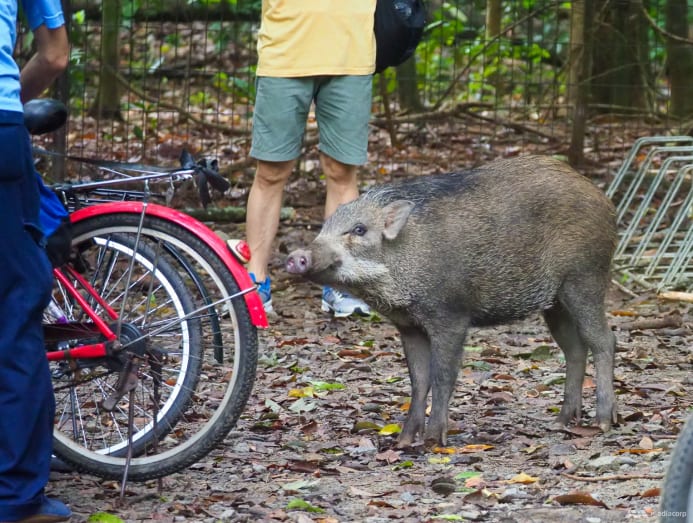
Deforestation also reduces habitats for wild animals, which could lead to increasing wild animals appearances in urban settings. These encounters may be trigger-happy: On Nov 17, a woman was attacked by a wild boar at a Pasir Ris park.
READ: Commentary: Are we inept at handling wildlife that come our mode?
At the same time, growing demand for housing, crowded MRTs and traffic congestion are all common challenges faced by Singaporeans. So how would we reconcile our need for infrastructure with the want to relieve our forests?
I believe that viewing construction versus conservation as a cipher-sum game is unhelpful. Instead, we should investigate how to develop land while preserving biodiversity and integrating nature into our urban landscape.
READ: Commentary: How do nosotros make up one's mind which buildings are worth conserving?
WHICH FORESTS SHOULD STAY AND WHICH SHOULD GO?
Identifying which forests are worth conserving at the city level is essential. Over the past six decades, large areas of state have naturally regenerated into secondary forests through spontaneous vegetation growth.
For example, the erstwhile 30ha Tagore-Lentor Forest – which in 2022 was cleared for the construction of private houses – was home to endangered flora and fauna, including the elephant foot fern and the Raffles' banded langur.
Depending on diverse characteristics, including proximity to nature reserves, historical land employ, topography and soil composition, secondary forests can flourish into habitats for unique, native species.
Sentinel: Climate change: Upwardly to half of Singapore'southward wild animals species could disappear past terminate of century | Video
Such forests, compared to younger forests dominated by a mix of scrublands and exotic tree species, are a higher priority for conservation due to their ecological significance.
Another consideration is the size of the forest: A larger forest has more potential to exist a biodiversity haven and also contributes more climate mitigation benefits.
Even so, due to intense, competing demands, removing a wood might become inevitable. If so, what might exist the next steps?
A mutual approach taken for construction is to simply clear all pre-existing vegetation – drastically altering or flattening the terrain and so that structure of buildings according to the proposed design can take place.

In contrast to this blank slate approach, I suggest saving habitats that have higher biodiversity within an area earmarked for evolution.
Such habitats include freshwater streams and patches of dense vegetation. They can be farther improved by introducing primary forest communities that increment functional and structural complexity of the remaining habitats.
A skillful example is the Bidadari manor development, where developers plan to preserve 10ha worth of woodland to sustain wildlife such as hornbills and flycatchers. The park will have up a tenth of the estate's infinite and will sit at the center of the residential manor.
Such an approach strikes the right residue between conservation and development. The estate planners acknowledge the value of retaining existing forest, and have sought to build the town around it, not over it.
READ: Commentary: Conserving Golden Mile Circuitous is a paradigm shift for Singapore compages
Forest patches can as well be converted to nature parks with both ecological and cultural value, such as Thomson Nature Park. Built over a former Hainan village, it is now home to critically endangered species such equally the dull loris and lesser mousedeer.
The educational utility of forests could extend even further. In Australia, bush schools allow children to appoint in recreational and educational activities outdoors.
READ: Commentary: The truth behind returning wildlife is less feel-good than you think
WHAT CAN Skilful Design Do TO COMPENSATE FOR Woods LOSS?
Partially preserving existing forests while maximising their utility requires long-term vision, and should be factored into urban planning.
Prior to mapping out edifice sites, planners could suggest a network of new green spaces that are in line with the existing terrain, h2o flows and naturally formed ecological corridors.

Secondly, in developing new public spaces, we should reuse and recycle what already exists on site rather than transporting large quantities of materials, such every bit top-soil and constitute materials, to and from it.
These suggested measures may increase costs. Reusing existing natural resources may cost more importing new materials. Increasing vegetation within housing developments would also subtract the number of buildable housing units.
Further efforts should be fabricated to observe an amusing degree of development that fulfills the interests of involved parties: Environmentalists, land developers, and regular citizens.
More detailed questions that demand to be considered include exist "What are the optimum sizes of greenery for particular ecological functions?", "What are maximum building limits that do not cake wildlife move?' and "Should in that location be laws protecting sensitive habitats regardless of their location?".
READ: IN FOCUS: How urbanised Singapore is learning to live with its wildlife
WATCH: Mandai makeover: Wildlife surveys monitor biodiversity and forest wellness | Video
Aside from the applied impact that clearing forests take on the urban planning needs of a country, forests give enormous intangible benefits to people too.
There are documented emotional and physiological benefits urban forests can accept. A group of scientists accept proved that how forest bathing (Shinin-yoku) can convalesce low and uplift moods, while improving immune system functions and lowering blood pressure level.
Managing secondary woods loss in Singapore is a wicked trouble. It involves seemingly contradictory interests from multiple perspectives – a large economical brunt versus ecological and biophysical consequences versus socio-cultural means.
To truly become a Metropolis in Nature, authorities, activists, citizens and planners alike must come up together to determine the fate of the land we work, live and play in.
Listen to an expert discuss why conserving forests and mangroves is critical to our fight against climate alter:
Yun Hye Hwang is an Associate Professor at NUS, an accredited landscape builder and mural researcher with expertise in socio-ecological design and management strategies that respond to emerging demands of loftier-density cities.
Source: https://cnalifestyle.channelnewsasia.com/commentary/clementi-forest-conservation-heritage-wildlife-biodiversity-park-293671
0 Response to "Commentary: Save forests or build 4-rooms? It’s not a zero-sum game"
Enregistrer un commentaire